
SDGs and the RPwD Act, 2016: Where Do We Stand?
India’s disability law and the world’s development goals both speak about mobility. This post looks at what they promise, what is happening on the ground, and where one person driving on their own fits into the bigger picture.
Why a driver’s seat belongs in a policy conversation
Laws and global goals can feel far removed from daily life. Yet for a person with reduced mobility, they come down to very ordinary questions. Can I get to work on time? Can I attend my classes? Can I visit my parents without arranging help?
Adaptive driving answers those questions at the level of one person. When we look closely, it also answers several commitments that India has made in law and on the world stage.
What the RPwD Act, 2016 says
The Rights of Persons with Disabilities Act, 2016 sets out the rights of persons with disabilities in India and the duties of governments and establishments. Several of its sections connect directly to independent mobility.
| Section | What the Act covers | Where adaptive driving fits |
|---|---|---|
| Section 3 | Equality and non-discrimination | Being able to travel independently gives equal access to work, study and community life. |
| Section 19 | Vocational training and self-employment | Driving is a practical life skill that opens the way to jobs and self-employment. |
| Section 20 | Non-discrimination in employment | A person who can commute on their own can take up a wider range of jobs. |
| Section 39 | Awareness campaigns | Outreach events and community sessions tell families that adaptive driving is possible. |
| Section 41 | Access to transport | Calls for schemes that promote personal mobility at affordable cost, including the retrofitting of vehicles. |
RPwD Act, 2016, Section 41(2), in summary
The appropriate Government shall develop schemes and programmes to promote the personal mobility of persons with disabilities at affordable cost, providing for:
- incentives and concessions
- retrofitting of vehicles
- personal mobility assistance
Read that list again. Concessions, adapted vehicles and help with personal mobility are exactly what our learners ask us about every day. The law describes the need clearly. The work of meeting it, one person at a time, is still under way.
Where the global goals meet the road
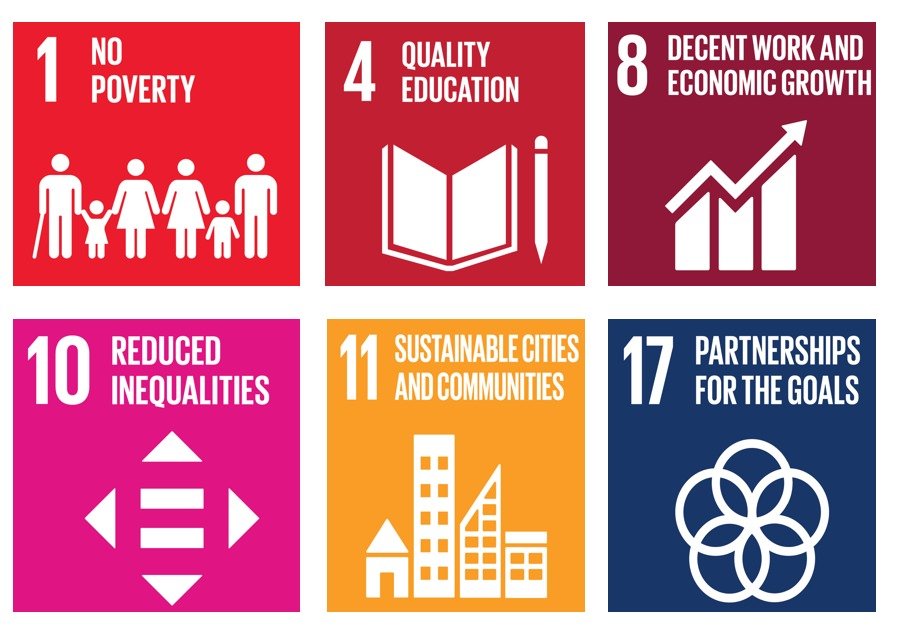
The UN’s Sustainable Development Goals give countries and companies a shared way to describe progress. Several of their targets mention persons with disabilities by name, and independent mobility touches each of the goals below.
|
01
No povertyWork and income reduce the risk of poverty for persons with disabilities and their families. |
04
Quality educationSkills for work, and equal access to vocational training. Targets 4.4 and 4.5 |
08
Decent workFull and productive employment for all, including persons with disabilities. Target 8.5 |
|
10
Reduced inequalitiesSocial and economic inclusion of all, whatever their disability. Target 10.2 |
11
Sustainable citiesAccessible transport, with attention to persons with disabilities. Target 11.2 |
17
PartnershipsPublic, private and civil society partners working together. Target 17.17 |
The view from the boardroom
The same connections show up in how Indian companies plan and report their responsibilities to society.
|
CSR under the Companies Act, 2013Schedule VII includes employment-enhancing vocational skills for the differently abled, and livelihood enhancement projects. BRSR reportingIndia’s largest listed companies report against nine principles of responsible business, including inclusive growth and the wellbeing of employees, with disclosures on differently abled employees. ESGDisability inclusion sits within the social side of ESG, which investors increasingly look at alongside financial results. Impact assessmentLarger CSR projects must now show measurable results, so outcomes matter as much as activities. |
That last point is why we pay attention to what changes after training, and not only to how many sessions we run. We wrote about this in Real Life, Real Change.
So, where do we stand?
The honest answer is: further along than ten years ago, and not yet where the law points.
| What is promised Personal mobility at affordable cost, retrofitted vehicles, concessions and equal access to work and public life. |
What we see Adaptive driving training is hard to find. Some of our learners travelled from other states to train. Information on modifications and concessions is scattered and varies by state. |
Where we help Personalised training, guidance on cars and modifications, help with concessions, awareness work, and support for families and employers. |
Government audits of the Act’s implementation have also pointed to gaps in accessible transport. None of this is a reason for gloom. It is a clear picture of the distance still to cover, and a reminder that the law works best when people on the ground help turn it into practice.
For us, every learner is a small, concrete step towards what the Act and the SDGs describe. Achla learnt to drive at 70. Rahul went back to work. Shivangi built her career in Bengaluru. Each of them moved from a promise on paper to independence in daily life, through the four stages we describe in Dream, Dare, Do, Drive.
Laws set the direction and global goals set the targets. Reaching them depends on families, companies, institutions, students and volunteers, each doing a part. There is room on this road for anyone who wants to help.
| Real Life, Real Change Four learners and what changed for them. |
Dream, Dare, Do, Drive The four stages every learner moves through. |
Our Approach How we work, and the principles behind it. |