
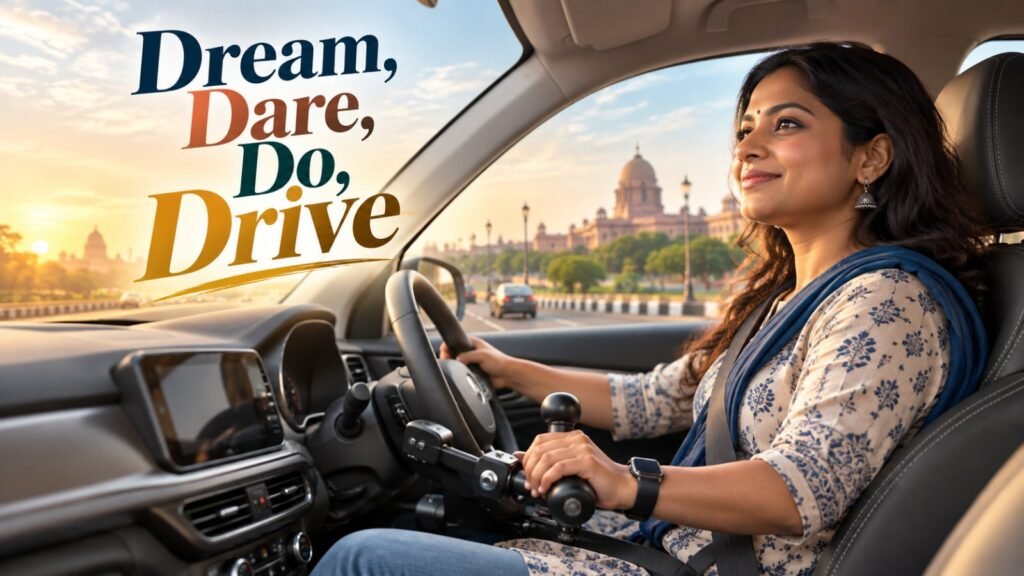
Dream, Dare, Do, Drive
Four words sit on the spokes of our steering wheel. Together they describe what it takes for a person with reduced mobility to go from wondering about driving to doing it every day.

It started with one question
At an event on disability, a woman named Anju walked up to our founder and said she wanted to learn to drive and be independent, just like her. It was a simple wish, and it was not the first time someone had felt it. What struck us was how few places in India could help her act on it.
Drive On My Own grew out of that conversation. Over time we noticed that every learner who reached the driver’s seat had passed through the same four stages. We drew them as a steering wheel, because a wheel only turns when every spoke holds.
Four steps. A more independent you.

|
1
DreamFor many persons with reduced mobility, driving has never even felt like an option. Nobody said it out loud, but the message was clear in how cars were designed, how families planned outings and how often the answer to “Can I go?” was “Who will take you?” So the first step is a belief. A person looks at the road and asks, “Could that be mine?” We want the honest answer to be yes. Being able to drive means going where you want, when you want, without having to ask. Sometimes the dream waits a long time. Achla Arora, a polio survivor, learnt to drive with us at the age of 70. |
2
DareA dream is easy to hold and hard to act on. Many of our learners have been told, gently or bluntly, that driving is not for them. Some have believed it for years. Courage grows faster in good company. Learners meet people who already drive with a disability, and they hear from guides who have lived the same doubts. They also get honest counselling about their own body, the controls that would suit them and what the training will ask of them. Honest advice builds more confidence than easy promises. The bravest moment is often the first phone call. |
|
3
DoThis is where the wish becomes a skill. Every learner starts with an assessment, then trains in a retrofitted car with hand controls or other adaptations, under a plan built around their body, their pace and their goals. Nobody learns alone. Behind every learner is a family that has worried, hoped and waited. We bring families into the process. They are briefed on the adaptations, prepared for what to expect and supported as their son, daughter, parent or partner gains confidence. Caregivers and community members often learn alongside the learner, so the confidence built in the car carries into life at home. |
4
DriveThe last stage is about making driving part of everyday life. We help each learner choose a suitable car, plan the right modifications and understand the concessions available to them. We stay with them until driving on their own feels normal. Then comes the first solo drive. It means something different to each person who witnesses it. |
Who the first solo drive belongs to
| The learner sees a wish they held for years come true. |
The family feels relief and pride as someone they love drives off on their own. |
The community sees proof that barriers once thought permanent can be crossed. |
What the road opens up
Driving is rarely the goal in itself. It is the way to reach the things that were hard to reach before: a job across town, a college course, a friend’s wedding, a weekly visit to a parent. Rahul Sharma, who lives with a spinal cord injury, went back to work once he could drive himself. Shivangi Agarwal, who has a congenital disorder, now works in Bengaluru.
Each of these changes brings more with it: an income, a routine, a sense of choice. Families spend less time arranging transport and more time simply being together. Over time, the person behind the wheel is seen differently, and sees themselves differently too.
Why all four spokes matter
A wheel with a missing spoke wobbles. A learner with a dream but no courage never starts. A learner with courage but no proper training does not stay safe. A learner with skills but no suitable car cannot drive at all. That is why we work through all four stages with every person, rather than stopping at the lesson.
Across India, many people with reduced mobility are still at the first spoke, quietly wondering whether the road could ever be theirs. Some have not yet heard that it can.
Our work is to help each of them move from that question to the moment they drive off on their own.