
Real Life, Real Change – From Outputs to Outcomes to Impact
A driving lesson is easy to count. What happens after it is harder to count, and it matters far more. This is a look at both, through the lives of four people who learnt to drive with us.
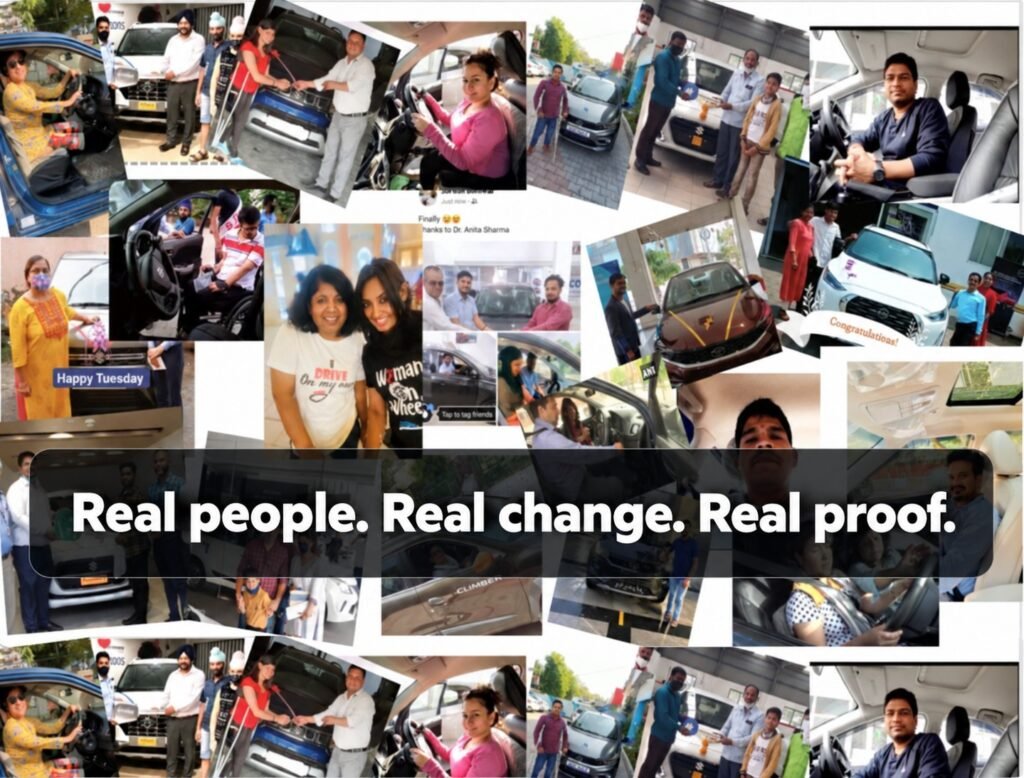
Real people. Real change. Real proof.
The easy number and the real one
Any training programme can tell you how many sessions it ran. That number is useful, but it only tells you what was delivered. It says nothing about whether anyone’s life is different because of it.
People who study social programmes use three words to keep this clear. Outputs are what a programme delivers. Outcomes are the changes that follow, often within months. Impact is the lasting difference in a person’s life, and sometimes in the lives of the people around them. A good programme is judged on all three, and most of all on the last.
For a person with a disability, learning to drive shows this chain very clearly.
How one driving lesson travels
The same programme, seen at three distances.
|
What we deliver Outputs
|
What changes in the months after Outcomes
|
What lasts Impact
|
Four people, four roads
Each of the people below came to us for the same output: driving training. What followed was different for every one of them.
 |
Achla AroraPolio survivor, trained in Noida Output Driving training at the age of 70. Outcome She fulfilled her dream of driving a car herself. Impact Her story tells every older person with a disability, and every family that has stopped hoping on their behalf, that it is never too late. |
 |
Dr. Inshah BashirSpinal cord injury, India basketball team captain Output Driving training in Chandigarh. Outcome She travelled from Kashmir to train, and returned able to drive. Impact The independence she shows on the court now extends to the road. Her decision to travel that far also shows how few places in India offer this training. |
 |
Rahul SharmaSpinal cord injury, trained in Amritsar Output Driving training and preparation for the licence. Outcome He went back to his job right after getting his licence. Impact Steady work means an income, a routine and a place among colleagues. For his family it means one less reason to worry. |
 |
Shivangi AgarwalCongenital disorder, now working in Bengaluru Output Driving training in Jaipur. Outcome She travelled from Delhi to train, and gained the freedom to move on her own. Impact Being able to drive opened up her working life. She now works in Bengaluru. |
What the stories have in common
Look past the individual details and a pattern appears. Two of these four people travelled across states just to learn. When people are willing to go that far, the need is real, and the supply is thin.
The changes also reach beyond the driver. A parent stops arranging every trip. A workplace keeps a skilled employee. A friend gets a visitor instead of a phone call. These ripples are the outcomes that rarely show up in a count of sessions, yet they are often what families mention first.

Learners and their families on the days that mattered: first drives, new cars and new licences.
| Families Confidence grows at home when a family sees their son, daughter or parent drive safely. |
Education and work Reaching college or the office no longer depends on someone else’s schedule. |
Community Weddings, markets, temples and meetups become places to go, not places to miss. |
Counting change honestly
It would be easy to claim every good thing in these stories as our own. It would also be wrong. Each learner had help from family, employers, retrofitters and transport offices, and above all from their own determination. Our part was to make driving possible. Their part was everything they did with it.
Good practice in measuring social change asks a few plain questions, and we think they are the right ones for a programme like ours:
Is the person still driving a year later?
Has being able to drive changed where they study, work or spend their time?
Who else helped make that change happen?
What did their family notice?
One thing works in our learners’ favour. Driving is a skill that stays. Unlike many short-term benefits that fade once a programme ends, a licence and the ability to use it keep giving for decades.
Why we start with the person, not the car
Every learner arrives with a different body, a different car budget and a different reason for wanting to drive. That is why each one begins with an assessment and a conversation, often with family present. The training, the controls and the car advice all follow from what that person needs.
It is also why we look beyond the lesson itself. A learner who has a licence but no suitable car, or a car with no proper modification, has not yet reached the outcome. So we help with car selection, modifications and the concessions the law provides, until the person can actually drive on their own.
Achla, Inshah, Rahul and Shivangi each took the same first step. Where it led was theirs to decide. Many more people across India are still waiting to take that step, and many are still travelling hundreds of kilometres to find someone who can teach them.
Bringing that first step closer to every one of them is the road ahead.