
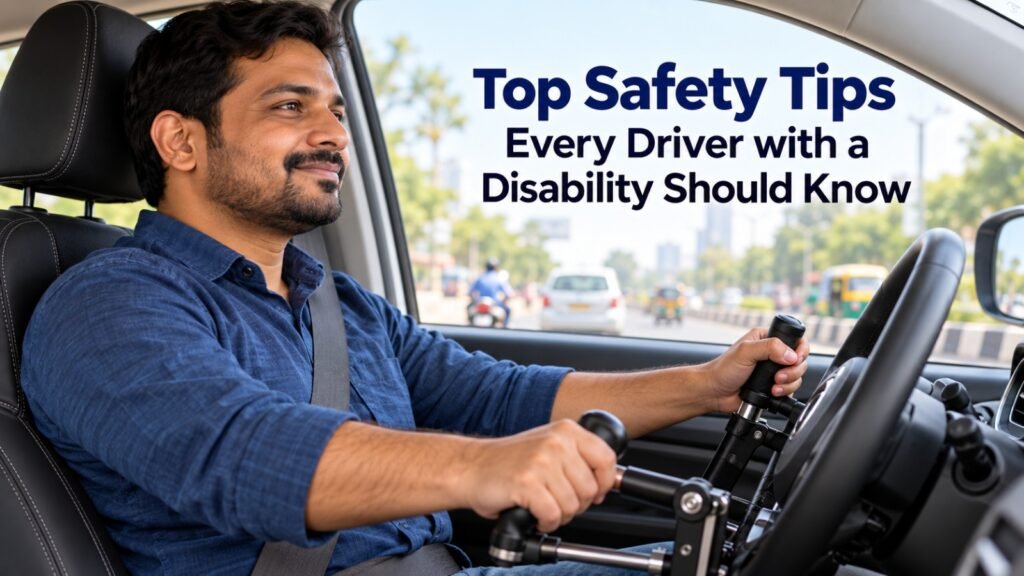
Top Safety Tips Every Driver with a Disability Should Know
Driving gives you freedom. A few steady habits make sure that freedom lasts. These seven tips come from what we see every day while training drivers with disabilities.
QUICK ANSWER
Check your hand controls and steering knob before every drive. Set up your seat, mirrors and mobility aid before starting. Plan an accessible route and share your live location. Keep an emergency kit within reach and save 112, 1033, 1091 and 108. Lock your doors in traffic, have a breakdown plan, and take breaks every 90 minutes to 2 hours.
The seven tips
- Check your adaptive controls before every drive
- Set up your seat, mirrors and mobility aid first
- Plan an accessible route and share your live location
- Keep an emergency kit and helpline numbers within reach
- Stay alert and keep the doors locked in traffic
- Know what to do if your car breaks down
- Listen to your body and drive within your limits
Check your adaptive controls before every drive
Your hand controls, steering knob or left foot accelerator do the work your body cannot. A loose bolt or a slipping knob can turn an ordinary turn into a dangerous one. Before you start, take 60 seconds:
|
15 SEC Hand control |
15 SEC Steering knob |
15 SEC Brake test |
15 SEC Quick look |
Have your adaptations inspected by a trained fitter every few months, and after any service at a regular garage.
Why it matters: a regular mechanic may not understand your modifications. Always tell the garage about them, and check the controls again when you collect the car.
Set up your seat, mirrors and mobility aid first
For many of us, getting into the car takes planning. Finish the setup before the engine starts, not at the first red light.
- Adjust the seat so you reach the hand controls with a slight bend in the elbow.
- Set all three mirrors. Add a blind-spot mirror if turning your neck or upper body is hard.
- Secure your wheelchair, crutches or walker so they cannot slide forward when you brake.
- Keep your mobility aid where you can reach it on your own in an emergency.
Plan an accessible route and share your live location
This matters for every driver, and especially for women who drive alone.
- Check road quality, flyovers, toll plazas and long stretches with no stops before you leave.
- Note fuel stations and restaurants on the way with accessible parking and washrooms.
- Share your live location with family or a friend on long or late drives.
- Avoid isolated shortcuts after dark, even if the map says they are faster.
- Park close to entrances in well-lit areas, and leave room on your door side for transfers.
Keep an emergency kit and helpline numbers within reach
Keep your kit where you can reach it from the driver’s seat, not locked in the boot.
| Phone, charger and power bank | First-aid kit and daily medicines | Water and a small snack |
| Torch and reflective warning triangle | Copies of licence, RC, insurance and UDID card | Card with emergency contact and medical information |
Save these numbers on speed dial:
| 112 National emergency: police, fire, ambulance |
1091 Women helpline |
1033 NHAI highway helpline |
108 Ambulance |
Stay alert and keep the doors locked in traffic
Common safety habits protect every driver. They matter even more when you cannot leave the car quickly.
- Lock the doors as soon as you are seated, and keep windows mostly up in slow traffic.
- Keep valuables out of sight.
- If someone signals that your car has a problem, do not stop on an empty road. Drive to a fuel station or a busy, well-lit place.
- If you think you are being followed, drive to a police station, petrol pump or crowded place and call 112.
- Keep the phone on a holder and use voice navigation. Never scroll while driving.
Know what to do if your car breaks down
This is one of the questions we hear most from learners. You may not be able to step out to push the car or change a tyre, and that is fine. What matters is having a plan.
| 1. Switch on the hazard lights and move to the left edge, as far off the carriageway as you can. |
| 2. On a highway or busy road, stay inside with your seat belt on. |
| 3. Call your roadside assistance number, or 1033 on national highways. |
| 4. Share your live location with family. |
| 5. Accept help only from verified assistance staff or police, and keep the window open just enough to talk. |
Tip: choose an insurance add-on with 24-hour roadside assistance, and tell the provider about your adapted car when you buy the policy.
Listen to your body and drive within your limits
Fatigue, pain and muscle spasms can slow your reactions. Driving with hand controls also tires the arms and shoulders faster on long drives.
- Take a break every 90 minutes to 2 hours on long journeys.
- Avoid driving when you feel unwell, or after medicines that cause drowsiness.
- Keep cushions or back support in the car if you need them.
- Build confidence in steps: quiet roads first, then city traffic, then highways.
Confidence is not about driving fast. It is about knowing you are in control.
Want to know more about the equipment itself? Read our guide to the types of steering knobs, and our simple guide to traffic rules and fines.
Frequently asked questions
| Can a person with a disability drive a car in India?Yes. Persons with locomotor disabilities can drive in India with a suitably adapted car, for example one fitted with hand controls or a steering knob, and a valid driving licence for that vehicle. Training on the adapted car is the safest way to start. |
| Is driving with hand controls safe?Yes, when the controls are professionally fitted, checked regularly and the driver is trained to use them. Most problems come from loose fittings or untrained use, not from the hand controls themselves. |
| What should a driver with a disability always keep in the car?A charged phone and power bank, a first-aid kit, daily medicines, water, a torch, a warning triangle, copies of your licence, RC, insurance and UDID card, and a card with an emergency contact and medical information. |
| What should I do if my adapted car breaks down on a highway?Switch on the hazard lights, move to the far left of the road, stay inside with your seat belt on, and call roadside assistance or the NHAI helpline 1033. Share your live location with family. |
| How can women drivers with disabilities stay safe at night?Plan the route in advance, share your live location, keep the doors locked, avoid isolated roads and park in well-lit spots near entrances. Save 112 and 1091 on speed dial. |
| How often should I take a break on a long drive?Stop every 90 minutes to 2 hours. Driving with hand controls tires the arms and shoulders faster, and fatigue, pain or spasms can slow your reactions. |
| Where can I learn adaptive driving in India?Drive On My Own Foundation (DOMO) in Jaipur trains persons with locomotor disabilities to drive independently in adapted cars, from the first lesson to confident solo driving. |
Safety keeps your freedom going. Check your controls, plan your route and keep your kit ready. You have worked hard to reach the driver’s seat, and these habits help you stay there.