
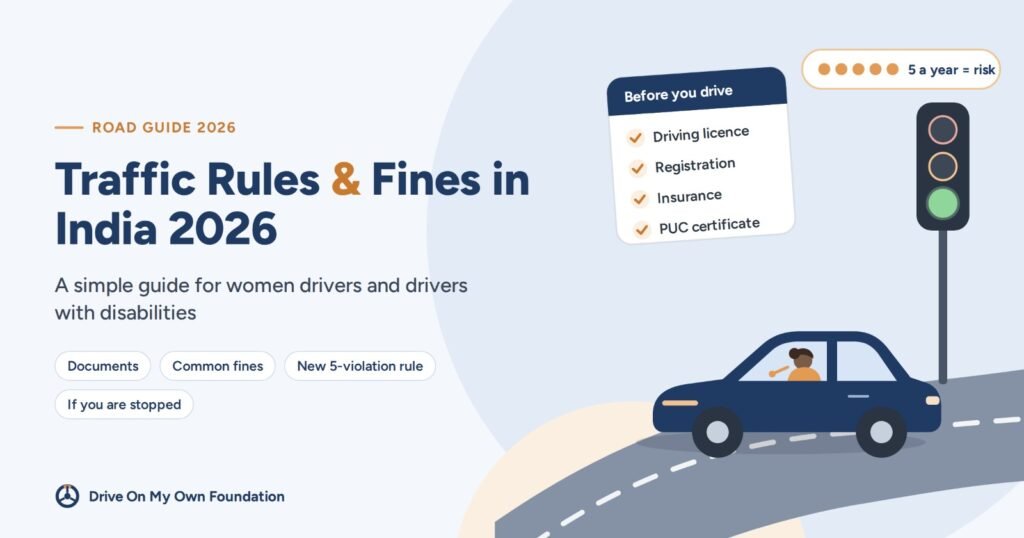
Traffic Rules and Fines in India 2026: A Simple Guide for Women Drivers and Drivers with Disabilities
Confidence on the road comes from two things: the skill to drive and knowing the rules. This guide covers the second, in plain language.
Quick answer
Traffic rules and fines in India are the same for every driver, including women and persons with disabilities. Carry your licence, registration certificate, insurance and PUC certificate, physically or in DigiLocker. Wear your seat belt, keep your phone away and respect speed limits. From 2026, five violations in a year can lead to licence suspension.
In this guide
- Do the same rules apply to everyone?
- What drivers of adapted cars should check
- Which documents to carry
- Common fines at a glance
- The five-violation rule
- If you are stopped by traffic police
- How to check, pay or contest a challan
- Frequently asked questions
Do the same traffic rules apply to women and drivers with disabilities?
Yes. The Motor Vehicles Act, 1988, as amended in 2019, applies equally to every driver in India. There is no separate rulebook for women, and none for persons with disabilities. That equality matters. It means a driver with a disability is held to the same standard, and is entitled to the same respect, as anyone else on the road.
Many of the learners who come to us tell us that fear of the unknown is as big a barrier as the driving itself. What happens if I am stopped? What if I forget a document? Knowing the answers takes much of that fear away.
What should drivers of adapted cars check?
If your car has hand controls, a steering knob, a left foot accelerator or other changes, three checks will keep you on the right side of the law.
1. Record the adaptation. Make sure the modification is recorded in your registration certificate. Unrecorded changes to a vehicle can attract penalties and cause problems with insurance claims.
2. Match your licence to your car. Your driving licence should cover the kind of vehicle you actually drive, including an adapted vehicle.
3. Inform your insurer. Tell your insurance company about the adaptations so your policy reflects the car you drive.
One rule is often misunderstood. The Act penalises driving when a person knows they are unfit to drive, for example because of illness, exhaustion or medication. A disability is not the same thing. A person who has trained on a suitably adapted car is not unfit to drive because of their disability. If you need help with modifications or paperwork, our Car Driving Solutions cover both.
Which documents must you carry while driving?
Keep these four with you every time you drive. Digital copies in DigiLocker or mParivahan are accepted as valid, which saves you from carrying paper.
|
DL
Driving licence |
RC
Registration certificate |
IN
Insurance |
PUC
PUC certificate |
What are the common traffic fines in India?
The table below lists common first-offence fines under the Motor Vehicles (Amendment) Act, 2019. The Act sets the limits, and each state decides its own amounts within them, so the fine you pay may be lower or higher depending on where you drive.
| Offence | First offence | Repeat offence |
|---|---|---|
| Documents | ||
| Driving without a valid licence | ₹5,000 and/or up to 3 months in prison | Same |
| Driving without insurance | ₹2,000 and/or up to 3 months in prison | ₹4,000 |
| Driving without registration | Up to ₹5,000 | ₹5,000 to ₹10,000 and/or up to 1 year in prison |
| Driving behaviour | ||
| Not wearing a seat belt | ₹1,000 | ₹1,000 |
| Overspeeding (car) | ₹1,000 to ₹2,000 | Licence can be impounded |
| Dangerous driving, including phone use and jumping a red light | ₹1,000 to ₹5,000 and/or 6 months to 1 year in prison | Up to ₹10,000 and/or up to 2 years in prison |
| Drink driving | ₹10,000 and/or up to 6 months in prison | ₹15,000 and/or up to 2 years in prison |
| Not giving way to an ambulance or fire engine | ₹10,000 and/or up to 6 months in prison | Same |
| Other | ||
| Using the horn in a silent zone | ₹1,000 | ₹2,000 |
| Disobeying orders of authorities | ₹2,000 | Same |
| Any offence with no specific penalty | ₹500 | ₹1,500 |
Based on the Motor Vehicles (Amendment) Act, 2019. Amounts vary by state. Check your state traffic police website for current figures.
What is the five-violation rule?
|
From 1 January 2026, if you collect five or more traffic violations in one calendar year, the transport authority can suspend your driving licence after giving you a notice and a hearing. Minor offences such as a seat belt or signal violation count. The count starts again each year. |
For anyone who has worked hard to reach the driver’s seat, losing a licence over small slips would be a real setback. The simplest protection is steady habits: belt on, phone away, eyes on the speed limit.
What should you do if traffic police stop you?
Being stopped can feel stressful, especially if you are driving alone or at night. These steps help you stay calm and safe.
|
1
|
Pull over safely where you are visible, switch on the hazard lights and stay inside the car with the doors locked. |
|
2
|
Lower the window just enough to talk. Politely ask for the officer’s name and identification. |
|
3
|
Show your documents, either on paper or through DigiLocker or mParivahan. |
|
4
|
If you have an adapted car, you can briefly explain the controls and show that they are recorded in your registration certificate. |
|
5
|
Pay a fine only through an official challan or e-challan, and keep the receipt. Do not hand over cash without one. |
|
6
|
If you ever feel unsafe, call 112, the national emergency number, and share your live location with someone you trust. |
How do you check, pay or contest a traffic challan?
Visit the official eChallan Parivahan portal and search using your vehicle number, challan number or licence number. You can pay online by card, net banking or UPI, or pay at a traffic police office or authorised bank. Under the 2026 rules, you have 45 days from the date of the challan to pay it or contest it online with supporting documents, such as photographs. Unpaid challans can block other transport services, so do not let them pile up.
Knowing the rules is part of driving on your own
Every learner who trains with us moves from wondering whether driving is possible to doing it every day. We describe that path in Dream, Dare, Do, Drive, and you can meet some of the people who have walked it in Real Life, Real Change. Knowing the rules is a quiet but important part of that independence. It lets you drive with your head up, and handle a traffic stop the same way any confident driver would.
Frequently asked questions
| Are traffic rules different for drivers with disabilities in India?No. Traffic rules and fines are the same for every driver. What differs is the vehicle: if your car has hand controls or other adaptations, make sure they are fitted properly and recorded in your registration certificate, and that your driving licence covers the vehicle you drive. |
| Is a disability the same as being “unfit to drive” under the Motor Vehicles Act?No. The offence of driving when unfit is about a person who knows they cannot drive safely at that moment, for example because of illness, exhaustion or medication. A person with a disability who has trained on, and drives, a suitably adapted car is not unfit because of the disability. |
| What documents must I carry while driving in India?Your driving licence, registration certificate, insurance certificate and Pollution Under Control (PUC) certificate. Digital copies stored in DigiLocker or mParivahan are accepted as valid. |
| What is the fine for not wearing a seat belt in India?Under the Motor Vehicles (Amendment) Act, 2019, the fine for not wearing a seat belt is ₹1,000. The driver is responsible for making sure passengers are buckled up too. |
| What is the fine for using a mobile phone while driving?Using a handheld phone while driving is treated as dangerous driving. The first offence can attract a fine of ₹1,000 to ₹5,000, imprisonment, or both. Repeat offences carry up to ₹10,000. |
| Can my driving licence be suspended for small violations?Yes. Under rules in force from 1 January 2026, five or more traffic violations in one calendar year, including minor ones such as a seat belt or signal violation, can lead to suspension of your licence after a notice and hearing. |
| How long do I have to pay or contest an e-challan?Under the 2026 rules, you have 45 days from the date the challan is issued to pay it or contest it online with supporting documents. You can check challans on the official eChallan Parivahan portal. |
| What should a woman driver do if stopped by traffic police?Stay calm and stay in your car with the doors locked. Lower the window slightly, ask for the officer’s name, and show your documents. Pay fines only through an official challan or e-challan with a receipt. In an emergency, call 112. |
This guide is for general information only and is not legal advice. Rules and fines change, and they vary by state. Please check your state traffic police or transport department for the latest position.
Thinking about learning to drive an adapted car, or helping someone you love do it? We can guide you through the training, the car and the paperwork.